
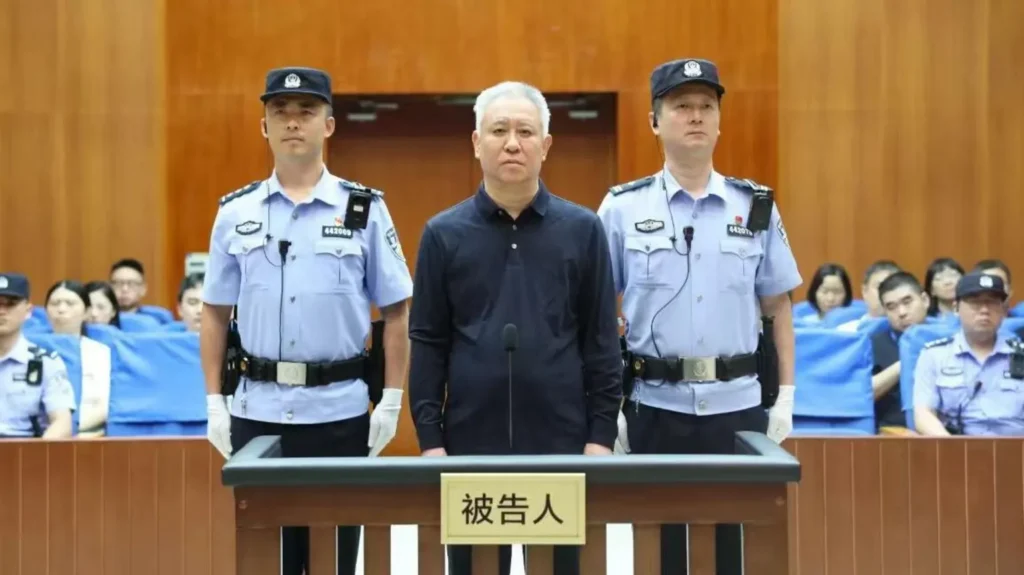
The spectacular downfall of one of China’s most powerful property tycoons has ended with a life sentence.
Hui Ka Yan, the founder of Evergrande, has been sentenced to life in prison after pleading guilty to multiple financial crimes, bringing a dramatic end to the career of a businessman who was once celebrated as one of Asia’s richest men.
The Shenzhen Intermediate People’s Court also ordered the confiscation of Hui’s personal property.
Hui pleaded guilty in April to charges including embezzlement of assets and corporate bribery. His former companies were hit with combined fines of 15.82 billion yuan ($2.35 billion; £1.73 billion) for offences including falsifying records and concealing debt, according to state media.
The court said Hui and his businesses had “seriously disrupted” China’s property market and caused significant economic losses.
From Billionaire Tycoon to Prisoner
Hui’s story is one of the most dramatic reversals in China’s corporate world.
Born into humble circumstances in rural China and raised by his grandmother, Hui entered the property business and founded Evergrande in 1996.
Over the following decades, he transformed the company into China’s biggest property developer.
Evergrande expanded at extraordinary speed, borrowing heavily to finance thousands of developments and turning Hui into one of the country’s most influential businessmen.
At the height of his success, the company was worth more than $50 billion on the stock market, while Hui was ranked among the world’s wealthiest individuals and was once considered Asia’s richest man.
But the empire was built on a mountain of debt.
The Debt That Brought Down an Empire
In 2020, Beijing introduced measures designed to prevent excessive borrowing by property developers.
For Evergrande, the new rules exposed a financial structure that was already under enormous pressure.
The company struggled to meet its debt obligations and began selling properties at steep discounts to generate cash.
Eventually, the strategy failed.
Evergrande defaulted in 2021, triggering a crisis that spread throughout China’s property industry and sent shockwaves through financial markets.
Homebuyers Left Waiting
The consequences extended far beyond investors.
During court proceedings, prosecutors said Evergrande had collected money from homebuyers through property pre-sales but failed to use the funds as intended for construction.
Instead, some of the money was allegedly redirected into other developments.
The result was hundreds of unfinished projects and thousands of buyers left waiting for homes they had already paid for.
The company’s collapse also placed enormous pressure on banks, suppliers, contractors and investors.
The Empire Loses Almost Everything
Hui’s downfall accelerated rapidly.
In 2024, Chinese regulators fined him $6.5 million and permanently barred him from the country’s capital markets after finding that Evergrande had overstated its revenue by approximately $78 billion.
Evergrande’s stock market value subsequently collapsed by 99%.
Its shares were eventually removed from the Hong Kong Stock Exchange in August 2025 after more than 15 years of trading.
Now, Hui himself has been sentenced to spend the rest of his life behind bars.
Other former Evergrande executives were also handed prison sentences. Hui’s two sons, Xu Zhijian and Xu Tenghe, received terms ranging from 22 months to 18 years, according to Xinhua.
A Fall With Consequences for China
Evergrande’s collapse became one of the defining symbols of China’s property crisis.
The real estate industry had been a major engine of China’s economic growth and an important source of income for local governments. At its peak, the wider property sector was estimated to account for around one-third of China’s economic activity.
But as developers accumulated debt and the housing market weakened, the problems spread.
Several other major property companies subsequently faced financial distress, while falling property demand and unfinished developments continued to weigh on the world’s second-largest economy.
Hui’s life sentence closes one of the most extraordinary chapters in China’s property boom — the rise and spectacular collapse of a billionaire who built one of the world’s largest property empires, only to watch it disappear under the weight of its own debt.