
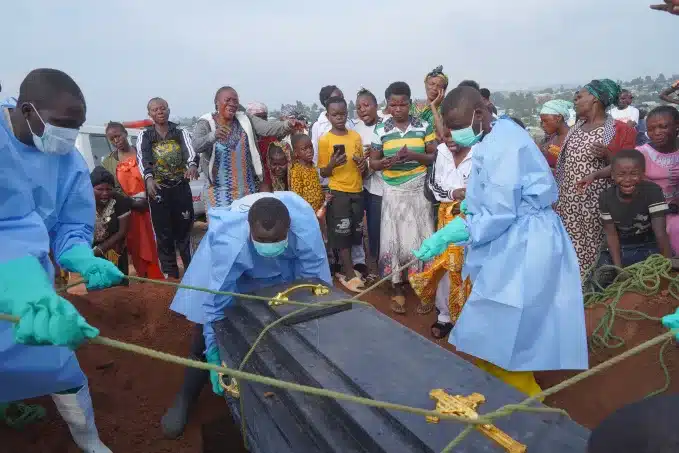
The Democratic Republic of Congo is facing its deadliest Ebola outbreak ever recorded, with more than 2,300 people now confirmed dead and thousands more infected.
Government figures show that 2,325 people have died and 4,945 confirmed cases have been recorded, making the outbreak deadlier than the country’s 2018–2020 epidemic, which killed 2,299 people.
The figures mark a grim turning point in an outbreak that was declared on May 15 and has spread with alarming speed.
A rapidly escalating crisis
The current epidemic has already become the largest Ebola outbreak in DR Congo by number of confirmed cases.
It is also now the second-deadliest Ebola outbreak ever recorded globally, surpassed only by the devastating West African epidemic of 2014–2016, which killed more than 11,000 people.
What is particularly alarming is how quickly the deaths have accumulated. DR Congo’s current outbreak crossed the 2,000-death mark in less than three months.
The virus has a major disadvantage: there is no approved treatment
The outbreak involves the Bundibugyo species of Ebola, a rare strain for which there is currently no licensed vaccine or proven treatment.

That leaves health workers fighting the virus largely through supportive care, isolation, surveillance and infection-control measures while experimental vaccines and therapies are assessed.
The fatality rate among confirmed cases has risen dramatically, reaching roughly 46–47%. Experts, however, say this does not necessarily mean the virus has become more lethal.
Instead, many patients are being diagnosed too late.
By the time some cases are identified, patients are already critically ill. Others are reportedly being discovered only after they have died in their communities.
Conflict is making the fight even harder
The outbreak is concentrated largely in parts of eastern DR Congo, where years of insecurity and armed conflict have created enormous obstacles for health workers.
Surveillance teams are struggling to keep pace with transmission, while violence, population movement, weak healthcare infrastructure and mistrust of authorities have complicated efforts to trace contacts and isolate suspected cases.
The virus has also reached Bas-Uele province, meaning six provinces have now been affected.
WHO declared an international health emergency
The World Health Organization declared the outbreak a Public Health Emergency of International Concern in May after Bundibugyo virus was confirmed in DR Congo and cases crossed into Uganda.
Uganda subsequently managed to contain its outbreak, recording 20 confirmed cases and two deaths before declaring an end to the outbreak.
But the situation in DR Congo remains deeply concerning.
As health authorities race to identify cases earlier and prevent further transmission, the latest figures underline just how difficult the battle has become.
The world’s attention is once again turning to DR Congo as one of Africa’s most serious Ebola emergencies continues to escalate.
Follow 10Seconds News for breaking African news, health alerts and major global developments.